

Introduction
Every research group has a bottleneck with a familiar shape: a scientist hunched over a terminal juggling FASTQ files, a dozen browser tabs open to NCBI and UniProt, and a half-finished pipeline tangled in next-step decisions. When deadlines loom, the difference between a week of friction and a morning of progress often comes down to how quickly you can move from question to dataset to analysis to result.
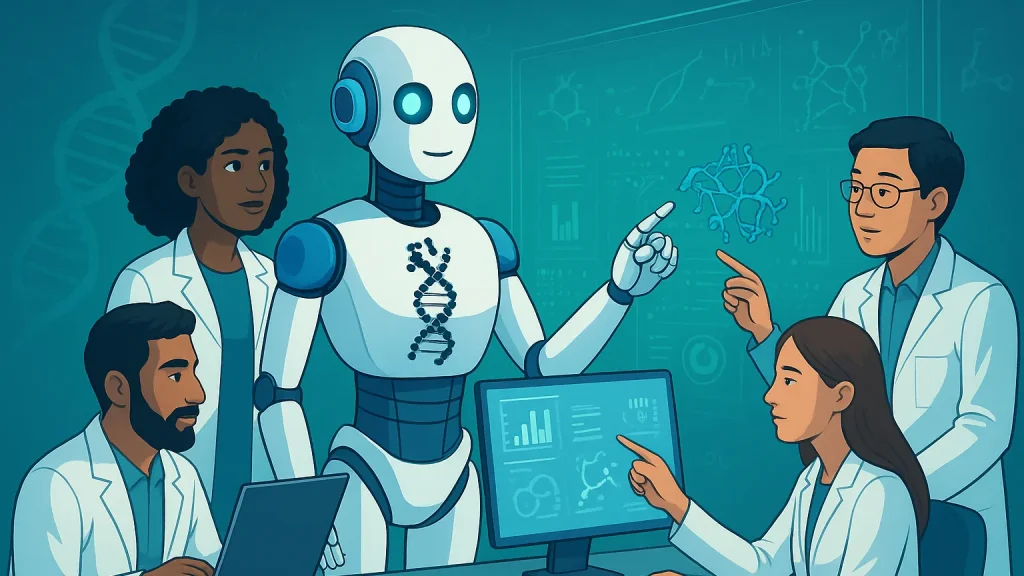
That’s where BioMNI comes in. Think of BioMNI as an AI agent designed specifically for computational biology. It doesn’t replace your expertise; it amplifies it. With a conversational interface backed by strong connectors to public databases, reproducible workflow engines, and your lab’s compute, BioMNI becomes the teammate who remembers the right flag for STAR, knows where the clean metadata lives, and drafts the nextflow.config you were dreading to write.
In this post, we’ll unpack what an “AI agent” means in the life sciences, show practical use cases, name concrete tools and databases it can tap, and outline how you can access and deploy BioMNI in real labs. Along the way we’ll demystify a few acronyms—LLM, RAG, GA4GH, VCF—and offer short examples you can adapt.
What BioMNI Is: An LLM-Powered Agent With Extensive Tools
At its core, BioMNI is a large language model (LLM) equipped with “tool use.” Instead of stopping at words, it calls external capabilities you already trust. Retrieval-augmented generation (RAG) supplies domain knowledge from curated sources, while tool adapters let it execute actions: query a database, launch a workflow, inspect a BAM header, or summarize QC metrics.
This matters because biology problems are multi-hop. A typical day might start with a literature skim, jump to fetching the matching GEO accession, continue through a Nextflow or Galaxy workflow, and end with a concise report for the PI. By weaving these steps together, BioMNI turns back-and-forths into a single, guided flow you steer with plain language. You stay in control, yet you shed the cognitive drag of remembering paths, flags, and file formats.
To make this safe and useful in real environments, BioMNI keeps context grounded in verifiable actions and artifacts. It logs what it did, which version of a pipeline it ran, which container image it pulled, and where outputs live. That audit trail is the difference between “AI magic” and science you’d publish with confidence.
What the Agent Can Do: From Data Discovery to Reproducible Analyses
Let’s make this concrete. Imagine you’re investigating a kinase inhibitor’s off-target effects in a lung cancer model. You ask BioMNI to find RNA‑seq datasets with similar perturbations, prefer human cell lines, and filter for poly(A) libraries. In seconds, it proposes candidate accessions, surfaces sample annotations, and drafts a small plan: download reads, run a curated RNA‑seq workflow, and generate a differential expression table with pathway enrichment. Because the agent knows about file formats—FASTQ, BAM, VCF—and common tools, it proposes a pipeline that’s both standard and lab-friendly.
When the workflow starts, BioMNI tracks provenance. It knows which reference build and gene annotation you picked. It also offers a summary dashboard: sequencing depth, duplication, mapping rates, gene body coverage. Instead of manually collating metrics, you can ask, “Are there batch effects across replicates?” and get a short, source-linked answer with plots.
Crucially, the agent helps beyond pure compute. It drafts a Methods paragraph tailored to the tools you actually ran, inserts version hashes and parameter values, and includes language about quality filters and multiple-test correction. Because it worked from your real run logs, it avoids the usual “template drift” that plagues manuscript sections.
The Data and Tools BioMNI Connects To
An agent is only as good as what it can reach. BioMNI’s value comes from speaking the language of established bioinformatics resources and reproducible compute. Here are the pillars it stands on.
On the data side, it can search across NCBI’s Entrez ecosystem to discover gene, genome, variation, and expression records, then follow those leads into specific repositories such as GEO and SRA. Entrez provides the unifying search layer many of us rely on daily, and the agent uses it to ground literature and dataset discovery in authoritative sources rather than ad-hoc scraping.
For protein-centric questions—say, mapping a variant’s position to a canonical isoform or fetching reviewed annotations—BioMNI taps the UniProt Knowledgebase. Because UniProt distinguishes between Swiss-Prot (manually reviewed) and TrEMBL (computationally annotated) records, you can guide the agent to prefer curated entries when precision matters, or broaden to predictive coverage when you need breadth.
On the workflow side, BioMNI integrates with engines you already trust for reproducibility. Nextflow is a natural fit: it lets you run containerized pipelines on laptops, HPC schedulers, or the cloud with the same command, and the nf-core community supplies rigorously maintained pipelines for common assays. The agent can scaffold a run, pick pinned versions, and surface expected outputs without hiding anything under the hood.
If you prefer a point-and-click environment or you’re teaching a course, Galaxy offers a mature web platform with thousands of tools, workflow composition, provenance tracking, and federation across public and private instances. BioMNI can launch Galaxy jobs, monitor progress, and retrieve results for downstream summaries—handy when you want team-friendly reproducibility without demanding everyone touch the command line.
Finally, when your analysis enters clinical or translational spaces, governance and interoperability become as important as raw speed. BioMNI’s data-handling patterns align with the Global Alliance for Genomics and Health (GA4GH) ethos: enable responsible, standards-based access while keeping patient privacy and consent at the center. That north star helps the agent negotiate the right trade-offs when connecting to controlled-access repositories or exchanging structured results.
Three End-to-End Use Cases That Show the Agent’s Range
To see how this plays out day-to-day, consider three short stories drawn from common lab needs.
Case 1: Rapid Omics Data Re-Analysis
First, a reanalysis sprint. Your lab inherits a promising single-cell dataset where clustering never quite stabilized. You ask BioMNI to fetch the counts matrix from the accession, harmonize gene symbols to current Ensembl IDs, and rerun a modern Scanpy workflow with doublet detection and batch correction. The agent produces a concise report comparing UMAP structures, marker robustness, and differential expression stability, then exports a ready-to-share AnnData file and a notebook appendix describing each step. Because the run is containerized and version-pinned, a collaborator can reproduce your exact figures tomorrow on a different system without wrestling with dependencies.
Case 2: Rare Disease Variants
Second, a rare disease variant triage. A clinician shares a VCF from a trio exome. You prompt the agent to prioritize candidates under a recessive model, annotate with population frequencies and ClinVar assertions, and generate protein-level consequences on canonical isoforms. The output is a shortlist with justifications and links back to source databases, plus a draft of the email you’ll send to schedule a multidisciplinary review. You refine the filters in plain language—tighten CADD thresholds, exclude low-complexity regions—and re-run without rewriting a command.
Case 3: Workflow Management
Third, a methods makeover. Your group plans to standardize multiple WGS workflows. Rather than starting from a blank page, you ask BioMNI to propose a baseline germline variant calling pipeline following GATK Best Practices, containerized for portability, with quality gates at each stage and a storage budget estimate for 50 samples. It writes a skeleton Nextflow script, a config with profiles for local and Slurm, and a README that explains how to override references and intervals. You still review and tune it, but you’re editing a credible first draft instead of hand-assembling one from memory.
Short, Practical Examples You Can Adapt
Examples are worth a thousand promises. Here are two quick snippets that show how you might work with an agent like BioMNI in everyday settings.
First, a small Python sketch that asks the agent to find protein records for a list of genes, download FASTA sequences, and save a multi‑FASTA. Treat this as illustrative pseudocode—you can adjust the tool adapters to match your environment.
# Example: conversational task + database tool use
from biomni import Agent

agent = Agent(profile="lab-default")  # picks your auth, compute, and storage
genes = ["TP53", "EGFR", "KRAS"]

task = f"""
For these genes: {', '.join(genes)}
1) Resolve canonical human UniProt accessions
2) Download reviewed protein FASTA
3) Write a single multi-FASTA to /lab/projects/panel/proteins.fasta
4) Log sources and versions used
"""

result = agent.run(task)  # agent coordinates Entrez/UniProt tools under the hood
print(result.summary)
Second, a tiny Nextflow skeleton the agent might generate when you say “set up a minimal RNA‑seq workflow with containerization and a QC checkpoint.” Simplified, but you get the idea.
nextflow.enable.dsl=2

process FASTQC {
  container 'biocontainers/fastqc:v0.12.1_cv8'
  input:
    path reads
  output:
    path "fastqc/*"
  script:
    """
    mkdir -p fastqc
    fastqc -o fastqc $reads
    """
}

process STAR_ALIGN {
  container 'quay.io/biocontainers/star:2.7.11b--h43eeafb_0'
  input:
    path reads
    path index
  output:
    path "aligned/*.bam"
  script:
    """
    mkdir -p aligned
    STAR --genomeDir $index --readFilesIn $reads --outSAMtype BAM SortedByCoordinate --outFileNamePrefix aligned/
    """
}

workflow {
  reads = Channel.fromPath(params.reads)
  index = file(params.star_index)
  FASTQC(reads)
  STAR_ALIGN(reads, index)
}
Because the agent emits both code and rationale, you can glance at why it chose those containers and what QC thresholds it expects to pass. If you use Galaxy instead, the agent can build an equivalent Galaxy workflow and import it into your instance with provenance intact.
How to Access and Deploy BioMNI in Your Lab
BioMNI meets scientists where they already work. In practice, teams adopt it in one of four ways.
The first is a JupyterLab or VS Code extension that adds a “Chat with BioMNI” panel to your notebook or dev environment. Because the agent can see the current directory, it can reason about your files, suggest fixes for failed rules, and draft code cells in your style.
The second is a command-line tool for scripted or headless use. You might run biomni run “re‑analyze GSEXXXXX with batch correction and export a final figure set,” pass a params.json, and let the agent orchestrate Nextflow or Galaxy calls behind the scenes while printing progress with clear, human-friendly logs. For reproducibility, the CLI writes a manifest that records inputs, references, containers, and command lines.
The third is a lightweight web app for shared work. PIs and analysts can review active jobs, approve access to controlled datasets, and inspect reports without opening terminals. Role-based access control and project-scoped secrets keep governance tight, and audit trails simplify compliance conversations.
Finally, there’s an API for integration. If your LIMS or data portal needs to kick off standardized analyses—say, every time a new SRA run is mirrored—BioMNI exposes endpoints to submit jobs, query status, retrieve artifacts, and capture structured summaries that downstream dashboards can render.
Because many biomedical projects must align with privacy and interoperability norms, the deployment pattern leans on recognized standards. GA4GH principles and related standards help frame responsible data access and exchange. Meanwhile, your pipelines stay anchored to community best practices—like those codified in GATK—so outputs are defensible in reviews and transferable to collaborators.
Summary / Takeaways
Computational biology is a relay race, not a single sprint. You start with a hypothesis, grab the right datasets, run a workflow, check the quality, and translate results into a story others can trust and reproduce. BioMNI is an AI agent built to pass those batons cleanly.
By combining an LLM with trustworthy tools, BioMNI helps you search NCBI and UniProt without losing metadata fidelity, set up robust Nextflow or Galaxy workflows without retyping boilerplate, and deliver auditable results with methods prose you don’t have to rewrite from scratch. It doesn’t replace your judgment; it lets your judgment reach further, faster.
If you want to feel this shift, start small. Ask the agent to find a public dataset, run a known pipeline, and export a tidy summary. Watch how quickly it moves from intent to execution to explanation. Then scale to your real production needs—more samples, stricter governance, and deeper integration with your lab’s stack. The work won’t do itself, but with BioMNI at your side, it will feel a lot more like science and a lot less like yak shaving.