

By EVOBYTE Your partner for the digital lab
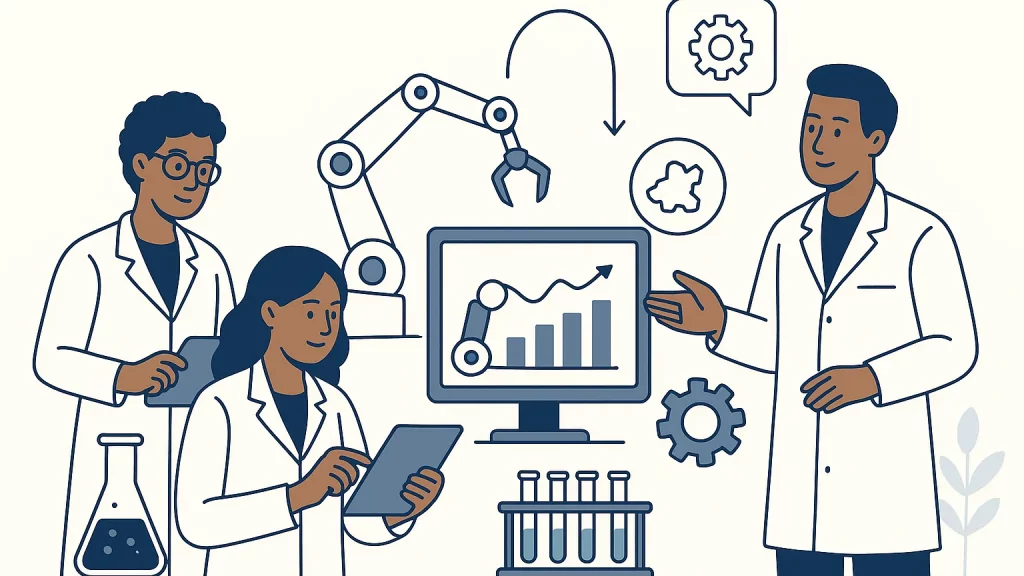
Autonomous Experimentation is one of the most talked-about ideas in modern labs, but the term is often used too loosely. A liquid handler with a script is not autonomous. A robot arm moving plates from one instrument to another is not autonomy either. True autonomy starts when a lab can design, run, measure, interpret, and adapt experiments in a continuous loop with minimal manual intervention. That requires more than equipment. It requires an architecture that connects Robotics, Analytics, and Decision Engines into one reliable operating model. Research on self-driving labs makes the same point: real closed-loop systems combine physical automation with digital processing and algorithm-guided experiment selection, and they depend on reproducibility, reconfigurability, and interoperability by design.
The distinction matters because many labs are investing in automation, yet still struggle to move faster. They may have an advanced liquid handler, a capable plate reader, and a data science team, but the handoffs between those parts remain manual. One scientist exports files, another renames them, and a third decides what to run next from a spreadsheet. That setup can look modern from the outside, but it still breaks the loop where it matters most. In a true Closed-Loop Automation workflow, the output of one experimental cycle becomes the structured input to the next cycle without human re-entry of data, missing context, or delays caused by disconnected systems. Studies of self-driving laboratories repeatedly show that the loop is not only about data flow, but about coordinating both data and material flow across instruments, software, and decision layers.
Why Autonomous Experimentation needs more than Robotics
The most visible part of autonomy is usually the robot. It is easy to see why. Robotics gives a lab immediate proof of movement, speed, and repeatability. Robots can pipette, transport plates, load samples, and trigger instruments with less variation than manual work. Recent work in self-driving labs describes robots as the physical execution layer that allows experiments to be designed, executed, and analyzed in a continuous cycle. But the same literature also makes clear that robots alone are not the system. The robot is only one layer in a larger architecture, and its value depends on how well it is integrated with analytical feedback and algorithmic control.
This is where many projects stall. A lab automates the wet-lab steps but leaves orchestration vague. In practice, someone still has to decide when the next run starts, whether an instrument is ready, which method file applies, where the result file lands, and how failed runs are handled. Research on interoperable orchestration platforms shows that self-driving labs often need custom scripts to connect hardware, data pipelines, and experimental planner modules, precisely because these pieces do not naturally fit together. That is why the scheduler or orchestration layer matters so much. It is the traffic controller for the whole loop. It decides what runs next, in what order, on which resource, with which parameters, and under which conditions. Without that layer, autonomy quickly becomes a set of isolated automations.
The integration layer behind Closed-Loop Automation
If the scheduler is the traffic controller, the integration layer is the road network. Instruments need a common way to expose commands, report status, and return results. The SiLA 2 specification was created for this kind of interoperability. Its vision is laboratory instrument integration and software services based on standardized communication protocols and content specifications, and it uses established technologies such as gRPC and HTTP/2 to support secure communication and interoperability across platforms and vendors. SiLA also supports discoverable device features, which is important because autonomous systems cannot depend on hidden vendor logic if they are meant to scale.
That sounds technical, but the business value is simple. When a liquid handler, balance, incubator, reader, or reactor exposes its capabilities in a standard way, the lab is less dependent on one-off connectors and fragile workarounds. A scheduler can ask, “Are you ready?” and get a reliable answer. A workflow engine can send a command without depending on a person to click through vendor software. A new instrument can be added faster because the integration pattern is already known. For labs planning growth, that matters more than any single robot purchase. It is the difference between building one impressive demo and building a platform that can survive real operations. Official and academic work on distributed self-driving laboratories emphasizes the same principle: modular resource abstraction and workflow coordination are essential if new resources are going to be plugged into the system without rewriting everything around them.
Data and Analytics are where most autonomy projects succeed or fail
Even with strong instrument control, a lab cannot claim Autonomous Experimentation if its data remains messy. The decision engine can only act on what it can trust. That means the data layer must capture more than raw values. It must include context such as sample identity, method version, plate position, timestamps, instrument settings, operator or system actions, and links between the physical sample and the digital record. The Allotrope Framework was built around this problem. Its Data Format is designed to standardize the acquisition, exchange, storage, and access of analytical data in laboratory workflows, while its models and ontologies support structured, reproducible, and verifiable use of that data.
This context is not an administrative detail. It is what lets Analytics turn measurements into decisions. If a chromatogram has no reliable metadata, the system cannot know whether a signal belongs to the current experiment, a calibration run, or a repeat injection. If a plate map is wrong, the optimizer may learn from mislabeled outcomes. If an analyst cannot trace why one run was excluded, the loop becomes hard to trust. Allotrope’s requirements highlight exactly these needs, including contextual metadata, long-term access, auditability, and support for analytical workflows and real-time measurements. In other words, autonomy depends on data discipline as much as on hardware speed.
A practical example makes this clearer. Imagine a formulation lab screening buffer conditions with a liquid handler and an HPLC assay. The robot can prepare dozens of samples quickly. The HPLC can produce rich data. But unless the results are automatically linked to the exact recipe, instrument method, sample lineage, and run quality flags, the next model recommendation may be wrong. The optimizer does not know that one sample clogged the injector or that a retention shift came from a method change unless that information is captured in the data system. This is why mature closed loops treat Analytics as an operational layer, not a reporting layer. The analysis pipeline must validate, normalize, score, and publish machine-readable outputs fast enough for the next cycle.
Decision Engines only work when the rest of the loop is stable
The most exciting part of the story is often the Decision Engines layer. This is where Bayesian optimization, reinforcement learning, or rule-based planners choose the next experiment based on prior outcomes. Research platforms such as AlphaFlow show how reinforcement learning can guide multi-step chemistry in a closed loop, while other orchestration systems demonstrate Bayesian optimization for adaptive exploration. These are powerful examples, but they also reveal an important truth: the model is not the product. The model is only as effective as the execution and data layers beneath it.
A good decision engine needs clearly defined objectives, constraints, and stopping rules. Is the lab optimizing yield, purity, cycle time, cost, or several goals at once? Are some combinations unsafe or infeasible? What should happen when an experiment fails halfway through? Distributed self-driving lab research shows that multi-objective closed-loop optimization works best when provenance is preserved and resources are orchestrated through a clear architecture that links goal requests, execution agents, and feedback data. That is why autonomy is as much about system design as it is about machine learning. The model cannot compensate for missing constraints, inconsistent measurement quality, or poorly handled exceptions.
For laboratory managers, this leads to a more practical definition of readiness. A lab is close to autonomy when it can trust the handoff between experiment request, robotic execution, analytical result, and algorithmic recommendation. It is not enough for the system to work on a good day. It must also recover from an empty tip rack, a delayed assay, a failed injection, or an instrument that goes offline. Recent software work in the field explicitly includes workflow management, low-code configuration, direct hardware control, and robustness layers such as databases, logging, and scheduling frameworks because closed loops have to operate in the real world, not just in clean demos.
The final point is strategic. Most labs do not need to jump straight into full autonomy. They do need to stop treating autonomy as a hardware procurement exercise. The better approach is to build a connected architecture in stages: standardize instrument communication, structure experimental data, automate analytical scoring, and then place decision logic on top of a stable foundation. When those pieces are aligned, Closed-Loop Automation becomes more than a vision. It becomes a repeatable operating model that shortens cycle times, improves reproducibility, and helps teams learn faster from every run. For organizations serious about Autonomous Experimentation, this is where custom integration software and fit-for-purpose data analytics often create the biggest advantage: not by replacing scientists, but by giving them a lab that can think and act as one system.
Further reading
- Ren, Z. et al. Autonomous experiments using active learning and AI. Nature Reviews Materials (2023). (nature.com)
- Volk, A. A. et al. AlphaFlow: autonomous discovery and optimization of multi-step chemistry using a self-driven fluidic lab guided by reinforcement learning. Nature Communications (2023). (nature.com)
- Bai, J. et al. A dynamic knowledge graph approach to distributed self-driving laboratories. Nature Communications (2024). (nature.com)
- SiLA Consortium. SiLA 2 Part (A) – Overview, Concepts and Core Specification v1.1. (sila-standard.com)
- Allotrope Foundation. Allotrope Framework Technical Reports and Allotrope Data Format. (docs.allotrope.org)