

By EVOBYTE Your partner for the digital lab
In modern Digital Labs, the real challenge is no longer buying capable instruments. It is making those instruments work together in a reliable, scalable way. That is where SiLA 2, OPC UA, and the broader conversation about Interoperability become central to Lab Automation. A lab can have a liquid handler, a plate reader, a balance, a freezer, a robot arm, and a LIMS, but if each system speaks a different language, automation slows down, data gets trapped, and every new connection becomes a custom project. Open standards exist to change that.
The easiest way to understand the modern lab stack is to think of it as a set of layers. At the bottom are devices, sensors, and machines. In the middle are orchestration, sample flow, scheduling, and control. At the top are business and scientific systems such as LIMS, ELN, analytics platforms, and dashboards. When these layers are linked by open standards instead of vendor-specific connectors, the lab becomes easier to scale, easier to validate, and easier to change over time. That is the real value of Interoperability: it protects the lab from fragile one-off integrations and closed ecosystems.
For many labs, the standards discussion is framed as a choice between SiLA 2 and OPC UA. In practice, that is often the wrong question. They were designed with different priorities, and that is exactly why they can complement each other so well. SiLA 2 was built specifically for laboratory devices and services. The SiLA Consortium describes it as a standard that specifies interoperability schemes for laboratory devices and services, using open communication protocols and a thin laboratory-specific layer with common concepts and vocabulary. It is also designed around self-describing services, discovery, and true plug-and-play behavior, which are highly valuable in multi-vendor lab environments.
Technically, SiLA 2 is based on HTTP/2 and Protocol Buffers, and it uses the gRPC wire format rather than inventing a new transport stack. That matters more than it may seem. It means labs and software teams can build on modern, widely used internet technologies instead of niche proprietary protocols. The standard focuses on functionality rather than device type, which is a practical fit for laboratories where users care less about a machine’s internal class and more about what it can do, such as dispense, shake, incubate, identify, measure, or report a result.
That service-based approach is one reason SiLA 2 is so relevant to Lab Automation. A SiLA-compliant client can discover a device, inspect the features it exposes, and interact with it through a standard structure of commands, properties, and responses. The standard also supports feature discovery, so software does not need to be written from scratch for every instrument if the same functional pattern already exists. For a lab manager, this translates into a simpler message: adding a new device should feel more like onboarding a new employee into a known workflow, and less like rebuilding the whole workflow from zero.
OPC UA, by contrast, comes from the industrial automation world. The OPC Foundation defines it as a platform-independent, service-oriented architecture that is secure, extensible, and built for comprehensive information modeling. It supports discovery, read and write operations, method execution, notifications, historical data access, and auditing. Just as important, OPC UA is built to scale from embedded devices and controllers to enterprise systems and cloud infrastructure. That makes it very attractive wherever lab environments start to look more like connected production systems.
Why SiLA 2, OPC UA, and Interoperability Matter in Lab Automation
A small lab can survive with manual workarounds and isolated software. A growing lab cannot. Once a team begins to connect more instruments, add robotics, or move data into centralized quality and analytics systems, poor Interoperability becomes expensive. Each custom interface increases maintenance effort. Each vendor-specific driver creates lock-in. Each missing context field hurts traceability. Open standards reduce that friction because they define not only how systems connect, but also how meaning is exchanged. In OPC UA, this is expressed through information modeling and companion specifications. In SiLA 2, it appears through standard features, feature discovery, and shared vocabulary for lab services.
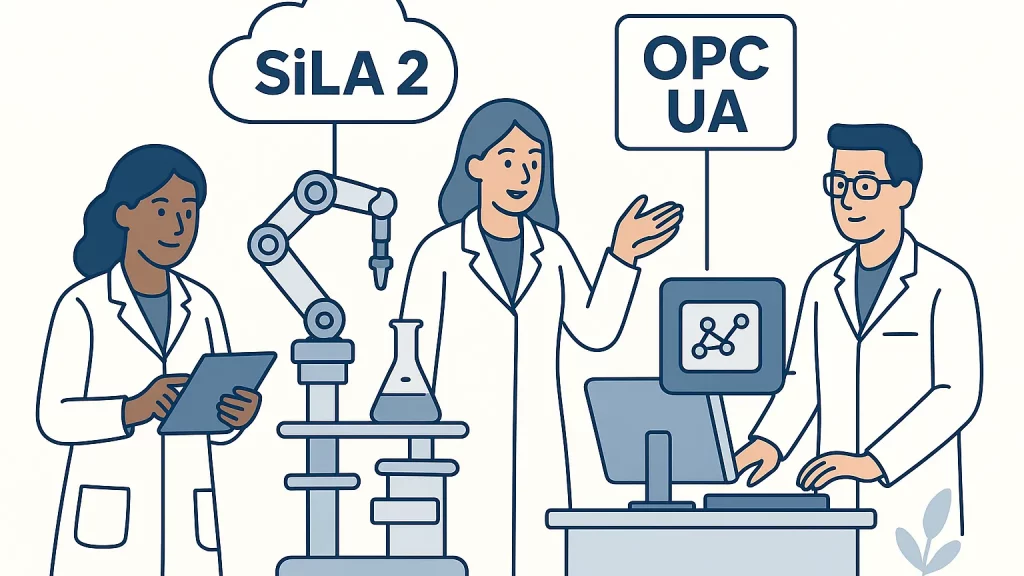
This becomes especially clear in robotics. Imagine an automated sample preparation cell with a robot arm moving plates between a decapper, a liquid handler, an incubator, and an analytical instrument. If every device exposes a different private API, the control software becomes a patchwork of special cases. If common standards are used, the robot controller, machine states, and cross-system status signals can be represented in a more consistent way, while instrument services can be exposed at the level scientists actually use. In that setup, OPC UA often shines where machine states, equipment structure, and multi-layer industrial communication matter, while SiLA 2 is often more natural where lab workflows need clear service calls such as starting a run, setting parameters, subscribing to results, or retrieving output in a lab-friendly structure. This is an architectural inference, but it aligns with how the two standards describe their intended scope. (sila-standard.com)
Traceability is another reason the standards conversation matters. In regulated or quality-sensitive environments, a lab needs to know what happened, when it happened, who triggered it, which method was used, and which device produced the result. SiLA 2 includes provisions for encryption, authentication, authorization, and audit trail functions, and the SiLA Consortium explicitly positions the standard as useful for data integrity and regulated environments. OPC UA also includes authentication, encryption, message signing, and auditing, and it supports historical and event-driven access patterns that are valuable in monitoring and investigation. These are not abstract features. They are the building blocks that make root-cause analysis, validation, and compliance easier when automation grows.
Vendor-neutral automation is where the business value becomes obvious. A lab that standardizes on open interfaces is in a stronger position when it replaces one plate reader, adds another robot, or connects an old instrument to a new data platform. Instead of rewriting the whole integration layer, the lab can keep the architecture stable and swap only the adapter or service that changed. That lowers long-term cost and shortens deployment time. It also reduces the risk that a single supplier defines how the entire digital lab must operate. For managers planning multi-year automation programs, this is often more important than any one device feature.
The strongest digital strategies therefore do not treat standards as a compliance checkbox. They treat them as infrastructure. A modern stack might use SiLA 2 to expose instrument capabilities, OPC UA to connect machines, controllers, and facility-level data, and then connect both into LIMS, ELN, scheduling tools, dashboards, and AI models through a unified software layer. This is also why custom integration still matters. Most real labs have legacy devices, partial standards support, and years of process history. A standards-first custom software approach can bridge those gaps without locking the lab into another hard-to-change silo.
There is also a broader trend worth noting. In May 2025, the OPC Foundation, Spectaris, and the Allotrope Foundation announced a lab-focused demonstration that integrated Allotrope models into the OPC UA framework to improve semantic interoperability in analytical labs. That matters because it shows the market moving beyond simple connectivity toward richer, machine-readable context. In other words, the conversation is no longer just about moving data from device A to system B. It is about moving data with enough structure and meaning that software, workflows, and analytics can trust and reuse it.
For labs planning their next automation phase, the practical lesson is simple. Do not ask only whether a device can connect. Ask how it connects, what standard it supports, how discoverable its functions are, how secure the connection is, how easily results can be traced, and how much custom work will be needed when the lab doubles in size. Those questions are what separate a demo-friendly setup from a scalable digital platform.
In the end, SiLA 2, OPC UA, and Interoperability are not side topics in Lab Automation. They are part of the foundation of successful Digital Labs. SiLA 2 helps labs expose instrument functions in a lab-friendly, service-oriented way. OPC UA brings secure, scalable, information-rich connectivity across machines, systems, and enterprise layers. Used thoughtfully together, they support vendor-neutral automation, stronger traceability, and a modern lab stack that can grow without becoming brittle. For laboratories that want to scale robotics, connect instruments faster, and prepare for advanced analytics or AI, standards are not a constraint. They are the path to flexibility.
Further Reading
SiLA 2 Part (A) – Overview, Concepts and Core Specification v1.1 (sila-standard.com)
SiLA FAQ: What is SiLA 2, why SiLA 2, and how SiLA 2 compares to OPC
OPC Foundation: Unified Architecture Overview (opcfoundation.org)
OPC Foundation: UA Companion Specifications (opcfoundation.org)
OPC Foundation press release on smarter labs and semantic interoperability with Allotrope, May 13, 2025 (opcfoundation.org)