

By EVOBYTE Your partner for the digital lab
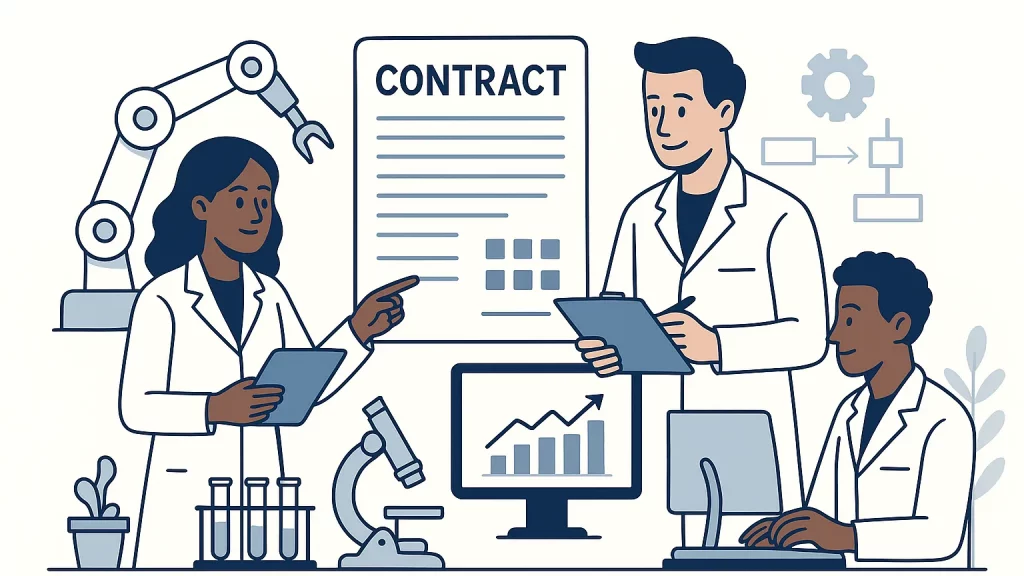
The modern lab runs on data, yet too often that data stumbles between tools. Files change shape without warning, field names drift, and units get lost in translation. When an instrument export confuses a robot, or a LIMS record confuses an algorithm, work pauses and teams scramble. Lab Data Contracts offer a simple, powerful answer. By defining an explicit agreement about what data looks like and how it behaves, they improve Interoperability across Laboratory Automation, raise Metadata Quality at the source, and create smoother handoffs into downstream Analytics Pipelines. In plain terms, a data contract is the lab’s promise that every dataset will arrive on time, in the right format, with the details needed to be trusted.
What Lab Data Contracts are—and why they matter
A Lab Data Contract is a shared specification that producers and consumers of lab data agree to follow. It defines required fields, accepted values, units, structure, and business rules. It spells out how to label samples, how to encode plate maps, how to represent units and limits of detection, and how to express status and error conditions. It sets expectations for completeness and timing, and it includes a clear version so change is safe and auditable. If an instrument or robot violates the contract—say by omitting a sample identifier or sending absorbance without units—the contract fails fast, the pipeline stops gracefully, and the team sees a clear error message. This is not heavy theory; it is the kind of everyday guardrail that prevents silent errors and weekend debugging sessions.
The value becomes obvious the moment you connect three or more moving parts. Picture a plate reader, a liquid handler, a scheduling system, and an analysis notebook. Without a contract, each integration must be custom-built and fragile. With a contract, each component plugs into a predictable shape. The liquid handler knows exactly how to send metadata about tips, deck position, and reagent lots. The reader emits results with plate coordinates, wavelengths, units, and QC flags. The scheduler attaches run identifiers and timestamps. The notebook receives a consistent dataset every time and turns it into insight without detective work.
Interoperability that survives real-world chaos
Interoperability in labs breaks less because of “format wars” and more because of inconsistent meaning. CSV is not the enemy; ambiguity is. When two devices both send a column called “conc,” one means micromolar and the other means milligrams per milliliter. When a robot writes “well” as “B7” and a data service expects “r2c7,” you are one off-by-one error away from rework. Lab Data Contracts resolve these mismatches in advance. They document the canonical unit for each measure, the expected casing and spelling for fields, the allowed values for status, and the timezone convention for timestamps. They can require globally unique sample identifiers and insist on stable, immutable run IDs so that traceability survives file moves and database migrations. By aligning on meaning first and format second, your lab gains integration that holds up when instruments change firmware or when vendors update export templates.
A common pattern we implement is to version contracts using semantic versions. A 1.0 contract can add optional fields in 1.1 without breaking compatible consumers, while a 2.0 release can make a deliberate breaking change, with both versions running side by side for a defined deprecation period. This maturity model mirrors how software teams manage APIs. The outcome for the lab is less surprise and more control.
Raising Metadata Quality at the source
Metadata Quality is usually treated as a downstream cleaning job, but the cheapest, cleanest time to fix metadata is at the moment of creation. A Lab Data Contract enforces this by validating completeness and coherence before data leaves the instrument or automation platform. If a required field like “sample_id” or “method_version” is empty, the export fails with a clear prompt, not a hidden blank. If a field mixes units, the exporter converts or rejects. If the plate layout references a well that does not exist for the plate type, the run cannot be marked complete. Adding simple rules such as “every measurement must include unit and calibration_id” eliminates a long tail of errors that tend to appear only when analysts try to reproduce results months later.
Consider a stability study where results flow for a year. Without contracts, lot numbers, storage conditions, and pull times are often encoded in free text, and subtle typos break trend analysis. With a contract, those fields come from a controlled vocabulary or predictable timestamp formats, so your Analytics Pipelines can calculate shelf-life without someone first deciphering a spreadsheet. In regulated settings, the audit benefit is immediate: required metadata is not a nice-to-have; it is structurally enforced.
A pragmatic blueprint for your first contract
Start by mapping the handoff between two adjacent systems. Pick a flow with real pain, like “liquid handler to plate reader to analysis.” List the questions analysts ask today when the data arrives. Which field is always missing? Which name is ambiguous? Which unit flips between runs? Translate those pain points into rules. Define the minimum fields all consumers must have to do their job reliably. Write precise names, types, and units. Specify how to represent nullable values and how to report errors. Ensure every dataset includes who produced it, when it was produced, under which method version, and with what calibration or reagent lot.
Next, embed validation where it is most effective: as close to the source as possible. Many instruments can export JSON or XML; many robots can run a small script post-run. If that is not possible, add a lightweight edge service that sits between the exporter and your LIMS or data lake. This service checks the payload against the contract, returns actionable errors to the operator, and forwards only valid data downstream. Place a human-readable manifest next to every exported file or batch, echoing the contract version and a checksum so that IT and QA can verify integrity.
It helps to choose a portable schema technology so contracts can be both human-friendly and machine-checkable. JSON Schema is approachable for most teams and works well for hierarchical data. Avro and Protobuf bring stronger typing and backward-compatibility features if you are streaming data at scale. Align with domain standards where possible so you do not invent what already exists. For device control, SiLA 2 can describe command and response payloads in a consistent way. For analytical results, AnIML or the Allotrope Data Model may cover many measurements and metadata out of the box. In clinical contexts, HL7 FHIR resources provide common language for orders and results. A good contract borrows, not isolates.
Contracts that help robots, not just analysts
Robots thrive on predictability. A liquid handler needs to know more than volumes; it needs plate type, deck location, tip type, and mixing strategy. A Lab Data Contract between a scheduler and a robot can encode these details in a stable structure. When the scheduler dispatches a job, the contract guarantees the robot receives valid parameters and that the robot reports back step-level outcomes and any deviations in a structured, parseable format. If a tip crash occurs or a temperature falls out of range, the event appears as a well-defined, machine-readable error with time and sensor context, not as an opaque log snippet. This makes recovery faster and analytics smarter because exception handling becomes data, not folklore.
In a real deployment, we saw a lab cut error investigation time by more than half after introducing contracts for deck layouts and run events. Before contracts, a misaligned plate name caused sporadic aspirate failures that took days to trace. After contracts, the system flagged the first incorrect plate type before a single tip moved.
Making Analytics Pipelines boring—in the best way
Reliable Analytics Pipelines love boring data. They thrive when today’s dataset looks like yesterday’s. Lab Data Contracts make that possible. Instead of each analysis script including ad hoc mapping to guess field names, the pipeline can trust stable semantics: a result array with known coordinates, a unit field that never lies, a QC flag with a fixed vocabulary, and a calibration reference that points to an unambiguous record. Versioned contracts also make reruns fair. If you must reprocess historical data, you can spin up the correct contract version in your pipeline, avoiding confusing apples-to-oranges comparisons.
In practice, this stability accelerates time to insight. A team building dose-response curves from plate reader data can go straight from a contract-validated dataset to curve fitting without writing a single line of cleanup code. Modelers can automate anomaly detection with fewer false positives because the metadata about method versions and reagent lots is consistent. Even dashboarding becomes simpler because field names are stable and reserved words are avoided by design.
Governance without the bureaucracy
Data governance can feel heavy, but Lab Data Contracts let you keep it light and effective. Nominate clear owners: one team that owns the producer side and one that owns the consumer side. Document how to propose changes, how to test them, and how to roll them out. Keep contract definitions in version control with short release notes that explain what changed and why. Provide a test dataset for each version and a reference validator that anyone can run locally. Adopt a short, predictable deprecation window so teams have time to upgrade without panic. This is enough process to prevent surprises without slowing science.
Change management becomes calm. When you introduce a new required field like “incubation_time_minutes,” you release it first as optional with warnings, then make it required in the next minor version after teams have had time to adapt. When you must rename a confusing field, you keep both names temporarily with one marked “deprecated,” and your validator nudges producers to update.
Integrating with existing Laboratory Automation and IT stacks
Contracts do not replace your LIMS, ELN, or scheduler; they make them work better together. Many LIMS can store the contract version along with each dataset and can reject uploads that fail validation. ELNs can embed validators in workflow templates so data pasted into a notebook cell is checked before it becomes a permanent record. Schedulers can require a valid contract payload before they dispatch a job to a robot. Data lakes and warehouses can partition data by contract version so analysts always know what they are querying. IT can monitor contract validation metrics like failure rates and drift over time to spot training needs or instrument misconfiguration early.
Security improves as well. Contracts can require that any personally identifiable or sensitive data be absent or encrypted, and validators can enforce those rules. This reduces the risk of sensitive information leaking into test environments or shared analytics sandboxes.
Conclusion: Lab Data Contracts are the missing link for Interoperability
Lab Data Contracts transform fragile, one-off integrations into dependable, testable connections. By agreeing on structure, units, and rules up front, your lab improves Interoperability across instruments, robots, and software, lifts Metadata Quality at the source, and feeds Analytics Pipelines with consistent, trustworthy data. The result is fewer surprises, faster science, and systems that scale as your lab grows. If you want smoother experiments, fewer night-and-weekend fixes, and a foundation that supports both discovery and compliance, start with a single contract and expand from there. Lab Data Contracts are a practical blueprint your team can put into action this quarter.
Further reading
- GO FAIR: The FAIR Data Principles — https://www.go-fair.org/fair-principles/
- SiLA 2 Standard for Laboratory Automation — https://sila-standard.org/
- Allotrope Foundation Data Models and Formats — https://www.allotrope.org/
- HL7 FHIR Overview — https://www.hl7.org/fhir/
- Analytical Information Markup Language (AnIML) — http://animl.org/