

By EVOBYTE Your partner for the digital lab
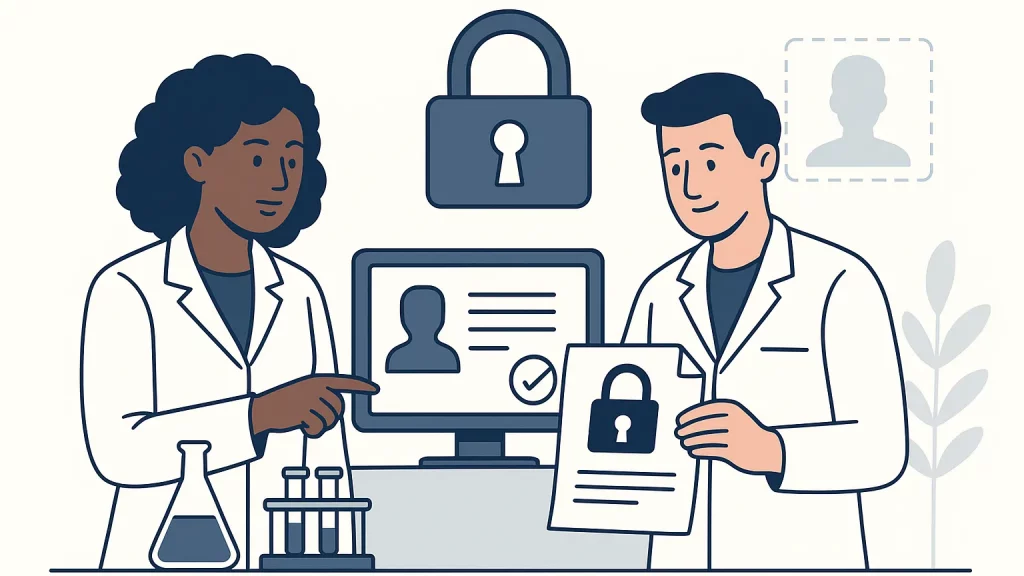
Patient data powers modern diagnostics and research, but it must be handled with great care. In a digital lab, strong data privacy practices protect individuals while enabling science to move forward. Two core techniques—anonymization and pseudonymization—help teams de-identify datasets so a person’s identity stays hidden without losing the value of the data for analysis.
What anonymization and pseudonymization mean
Anonymization is the permanent removal or transformation of identifiers so that no one can reasonably re-identify the person. After anonymization, there is no key, code, or side file that can link the data back to the individual. Think of converting a patient’s date of birth into a broad age range, removing addresses and medical record numbers, and aggregating rare conditions so individuals cannot be singled out.
Pseudonymization replaces direct identifiers with a substitute—often a random code—while keeping a separate, securely stored key that allows re-linking under strict controls. Here, the dataset looks “named” only by a token such as 9F3A-21C, and the mapping file lives in a vault with limited access. This preserves the ability to follow up with the same patient later, for example to add outcomes to a study, while keeping working copies of the data free of obvious personal details.
Why datasets need to be de-identified in the lab
De-identification is a practical safeguard for data privacy and a compliance requirement under health and research regulations. It reduces the risk of harm if a spreadsheet or report is misplaced or shared too widely. It also lowers exposure to re-identification attacks that link seemingly harmless fields—like birth date, postal code, and gender—across different sources. By building anonymization or pseudonymization into routine workflows, a digital lab can share insights faster with collaborators, auditors, and analytics teams without exposing who the data came from.
Practical examples for the digital lab
Consider a biobank study that wants to analyze longitudinal biomarker trends. Pseudonymization is a good fit: the lab replaces names and medical record numbers with random IDs and stores the re-identification key in a hardware-secured vault. Analysts see only coded IDs, yet authorized clinicians can re-link records to update consent or report a clinically relevant finding.
Now think about training an AI model to detect patterns in de-identified imaging. Anonymization works best here: strip all direct identifiers from images and headers, blur any visible labels, generalize dates to months or study intervals, and remove rare attributes that could single out a person. Once anonymized, the dataset can be shared with external partners with minimal residual risk and without the need for a re-identification key.
From policy to practice in your digital lab
Successful de-identification is more than a one-time scrub. Start with a clear data inventory so you know which fields identify a person outright and which can combine to do so. Build standard, testable rules for anonymization and pseudonymization into your LIMS or ELN so the process runs automatically when data moves between systems. Protect any re-identification keys with strong encryption, role-based access, and audit trails. Record patient consent and data-use purposes alongside each dataset so teams know when coded re-linking is permitted and when information must remain anonymous. Finally, validate that de-identified data still supports your scientific questions; if not, adjust generalization rules until you hit the right balance between privacy and utility.
Conclusion: choosing anonymization or pseudonymization for data privacy in the digital lab
Both anonymization and pseudonymization strengthen data privacy, but they serve different needs. Use pseudonymization when you must re-link data under strict governance; use anonymization when sharing or publishing data where re-identification should be impossible. Done well, de-identification lets a digital lab move faster, collaborate wider, and protect patients at every step.
At EVOBYTE, we help laboratories design and implement robust anonymization and pseudonymization workflows inside LIMS and analytics platforms, from key management and access controls to validation and reporting. Get in touch at info@evo-byte.com to discuss your project.
Further reading
HIPAA Guidance on De-identification of Protected Health Information (U.S. HHS): https://www.hhs.gov/hipaa/for-professionals/privacy/special-topics/de-identification/index.html
GDPR text and definition of pseudonymization (EU): https://eur-lex.europa.eu/eli/reg/2016/679/oj
ISO 25237:2017 Health informatics — Pseudonymization: https://www.iso.org/standard/63553.html
NISTIR 8053: De-Identification of Personal Information: https://csrc.nist.gov/publications/detail/nistir/8053/final