

By EVOBYTE Your partner for the digital lab
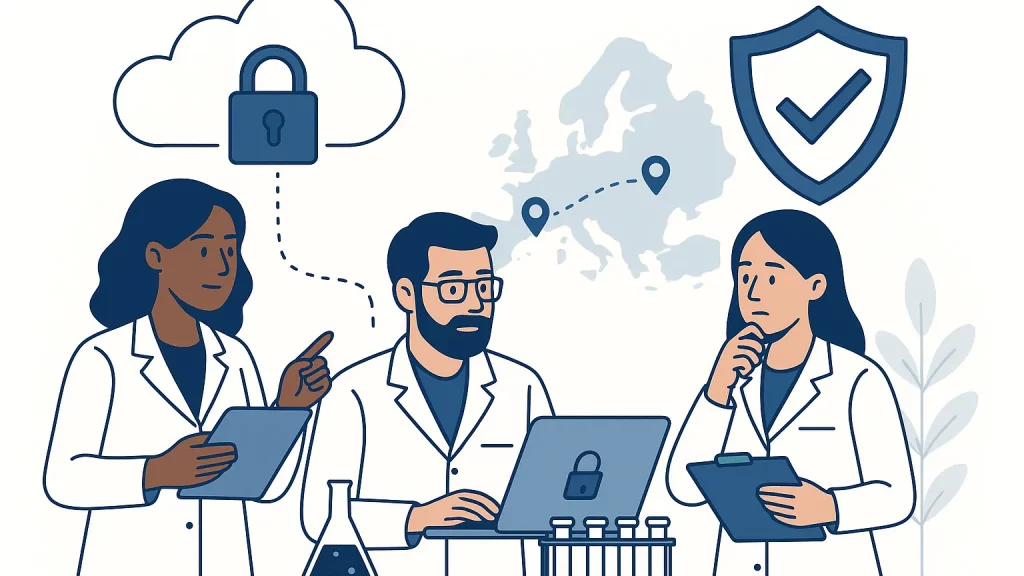
Data sovereignty is now a board-level topic for every digital lab. As teams adopt cloud LIMS, connected instruments, and AI analytics, decisions about data storage determine who can legally access your results, where the files physically live, and which rules apply. Getting this right protects your intellectual property, preserves patient and study privacy, and keeps your operation audit‑ready. In this article, we define data sovereignty in plain language, explain why cloud computing has pushed it to the forefront, and outline practical choices for data storage inside and outside Germany and the EU—plus what to verify when selecting a software vendor.
What “data sovereignty” really means
Data sovereignty means your organization controls its data under the laws of the place where the data is stored and processed. Put simply: the server’s location and the provider’s legal home shape what government requests, compliance duties, and security practices apply. For a lab, that includes raw instrument output, LIMS records, ELN entries, audit trails, method files, and derived analytics. True sovereignty blends legal, technical, and operational control: you decide the location, you hold the keys, and you can prove who accessed what and when.
Why cloud computing puts sovereignty in the spotlight
Cloud promises elasticity and lower upkeep, but it also blurs borders. A “EU region” can still involve global support teams, cross‑region backups, and third‑party subprocessors. Some providers may be subject to laws that allow foreign authorities to request data, even if the bits sit in Frankfurt. Cross‑border transfers, international research collaborations, and AI features that move data to external models add further complexity. This is why data sovereignty is discussed so much in cloud contexts: convenience can unintentionally expand your legal exposure unless you design for locality and control from day one.
How and where a digital lab should store data
Start with a data map. List the systems that create or hold data—chromatography stations, microscopes, sequencers, LIMS/ELN, image stores, reporting tools—and classify the content by sensitivity and retention needs. Then match each class to the right storage pattern.
Highly sensitive IP or patient‑related data often benefits from EU‑resident storage with strict access controls, ideally in Germany when possible. Many labs use a hybrid model: hot data stays close to instruments on secured on‑premises systems or an EU private cloud for low latency and continuity; warm and cold data move to EU‑based object storage with lifecycle rules, versioning, and immutability for audit retention. For regulated workflows, choose storage that supports write‑once‑read‑many options, detailed audit logs, and time‑stamped version control so your validation evidence is always intact.
When research collaboration requires wider access, consider a “sovereign by default, share by exception” design. Keep master records in an EU region you control. Share derivatives or de‑identified subsets through controlled workspaces. If you use AI for analysis, prefer EU‑hosted options with clear data handling terms, and avoid sending raw, identifiable data to external models unless a data processing agreement explicitly covers it.
Risks when using external servers and cloud providers
The biggest risk is jurisdictional exposure. If a provider—or its parent company—is subject to non‑EU laws that can compel access, your lab data could be requested without you being notified. Transfers outside the EU raise further duties for safeguards and assessments. Even within the EU, misconfiguration can undermine protection: overly broad admin roles, shared credentials between vendor staff, or cross‑region replication can all weaken your data sovereignty in practice.
There are operational risks too. Vendor lock‑in makes it hard to leave if a contract changes. Egress fees or proprietary formats can trap large image sets and raw files. Outages, delayed restores, or incomplete backups can disrupt batch releases and studies. Finally, third‑party subprocessors—used for monitoring, support, or AI features—can widen the attack surface if not vetted carefully.
Inside Germany and the EU versus outside
Hosting in Germany gives you the strongest alignment with local law and often the lowest latency to instruments and sites. EU‑wide hosting is usually a close second, provided the provider can guarantee EU‑only support, logging, backups, and keys. Outside the EU, the bar is higher. You will need explicit contractual safeguards, documented transfer assessments, and continuous monitoring of subprocessor changes. For global teams, a practical approach is to store master data in the EU and replicate de‑identified, minimal datasets to non‑EU regions only when needed, with separate encryption keys and strict time‑bound access.
What to check when evaluating vendors and solutions
Ask first about location. Can the vendor keep all data, backups, logs, and disaster recovery within Germany or the EU, and can they prove it? Then clarify key control. Strong data sovereignty depends on encryption with customer‑managed keys stored in EU hardware security modules, plus the option to keep keys in your tenancy (BYOK/HYOK). Confirm end‑to‑end encryption in transit and at rest, and check that administrators’ access is just‑in‑time, time‑boxed, and fully audited.
Look for transparent governance: a GDPR‑compliant data processing agreement, a public, up‑to‑date subprocessor list, and clear incident response commitments with defined SLAs. Independent assurance strengthens trust; certifications such as ISO 27001, SOC 2, and BSI C5 show that controls are in place and tested. For lab operations, make sure the platform supports immutable audit trails, time‑stamped versioning, and role‑based access aligned to your SOPs and validation requirements.
Plan your exit on day one. Demand documented data portability with bulk export in open formats, verified restore tests, and predictable egress costs. Validate recovery objectives that fit your process cadence—if you sample every hour, your recovery point objective should not be a day. Finally, ensure network controls, such as private links and IP allow‑listing, so instrument PCs and LIMS traffic never traverse the public internet unprotected.
Bringing it together
Data sovereignty in the digital lab is not a slogan; it is a set of concrete choices about data storage, keys, locations, and controls. By mapping your data, prioritizing EU‑resident hosting, keeping cryptographic control, and demanding verifiable governance from vendors, you reduce legal risk and keep science moving without interruptions. The result is a lab platform that is compliant by design and collaboration‑ready, with data sovereignty preserved from instrument to insight.
At EVOBYTE, we help laboratories design and implement sovereign, EU‑resident architectures for LIMS, ELN, and analytics—on‑premises, private cloud, or hybrid. If you are planning a migration or vendor evaluation and want practical guidance on data storage, encryption, and compliance, get in touch at info@evo-byte.com to discuss your project.
Further reading
EUR‑Lex: General Data Protection Regulation (GDPR) text — https://eur-lex.europa.eu/eli/reg/2016/679/oj
European Commission: EU‑US Data Privacy Framework adequacy decision — https://commission.europa.eu/law/law-topic/data-protection/international-dimension-data-protection/eu-us-data-privacy-framework_en
U.S. Department of Justice: Clarifying Lawful Overseas Use of Data (CLOUD) Act resources — https://www.justice.gov/dag/cloudact
BSI (Germany): C5 — Cloud Computing Compliance Criteria Catalogue — https://www.bsi.bund.de/C5