

By EVOBYTE Your partner for the digital lab
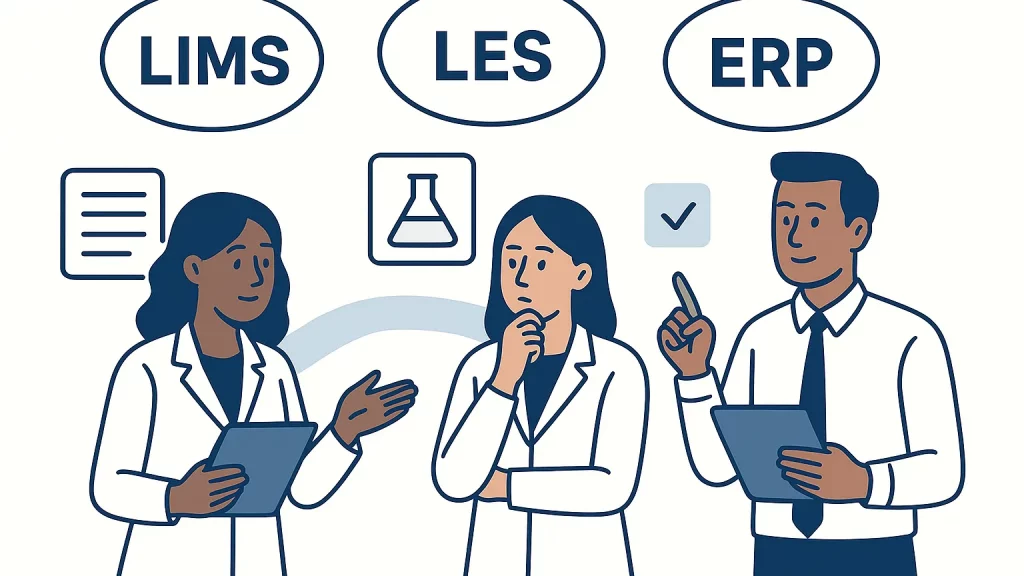
If you are planning your digital lab infrastructure, you will quickly meet three acronyms that shape every decision: LIMS, LES, and ERP. Each system solves a different problem in the laboratory, but they overlap enough to cause confusion. In this guide, I define each term in plain language, explain when each system is used, and share the real‑world questions leaders ask to decide what to buy first. Whether you run a high‑throughput QC lab or a flexible R&D group, understanding how lims, les, and ERP work together will save you time, cost, and headaches.
Clear definitions: what LIMS, LES, and ERP mean in practice
A Laboratory Information Management System, or LIMS, is the lab’s system of record for samples, tests, and results. Think of it as the traffic controller for the analytical life cycle. It assigns sample IDs, routes work to instruments or benches, applies test methods, records results, and locks everything with audit trails and electronic signatures when needed. Good LIMS software also manages stability studies, environmental monitoring, reference standards, inventory tied to tests, and quality events. In short, it connects people, instruments, and data so that nothing gets lost between login, analysis, review, and release.
A Laboratory Execution System, or LES, digitizes step‑by‑step work at the bench. Where LIMS manages “what gets tested and why,” LES governs “how the analyst performs each step.” It replaces paper SOPs with guided screens, captures weights and volumes as you go, checks calculations in real time, and prevents skipping a critical step. If a method says to equilibrate a column for 30 minutes, LES can enforce the wait and log the timestamp. If the balance drifts out of tolerance, LES can block the run and prompt a check. The result is fewer deviations and a clear, time‑stamped record of execution. Many teams describe LIMS as sample‑centric and LES as method‑centric, which is a helpful way to remember the difference.
Enterprise Resource Planning, or ERP, is the company‑wide backbone for finance, procurement, inventory, manufacturing, and order fulfillment. From a lab perspective, ERP supplies the materials master, batch numbers, and customer orders; it receives quality statuses and certificates of analysis when testing is complete. While ERP is not a laboratory system, it anchors cross‑functional processes like batch release or supplier qualification. Your lab may live day‑to‑day in LIMS and LES, but commercial commitments, costing, and planning depend on the ERP view of the world.
Building digital lab infrastructure: where LIMS, LES, and ERP fit
Modern digital lab infrastructure uses a hub‑and‑spoke pattern. The LIMS is the hub for laboratory data, master methods, and sample flow. The LES sits closest to execution at the bench and exchanges instructions and results with the LIMS. The ERP connects on the enterprise side, providing item numbers, lots, production orders, and receiving quality release decisions. Instruments plug into this network through interfaces that send raw or processed results to the LIMS or directly into the LES step where the data belong. When this architecture is in place, a sample logged from ERP appears in the LIMS queue, the LES guides the analyst through execution, and the final decision flows back to ERP without manual retyping.
A simple story makes this concrete. A pharmaceutical QC lab receives ten lots from manufacturing. ERP creates inspection lots and pushes them to LIMS. The LIMS assigns tests and due dates, pre‑allocates columns and reagents, and triggers instrument schedules. When an analyst starts an HPLC assay, the LES presents the approved method, checks column IDs, captures balance readings automatically, enforces calculation rules, and stores intermediate data. Once the run finishes, results are reconciled in LIMS, second‑person review is performed, and the final status releases to ERP so the lot can ship. Every action is traceable, every transfer is electronic, and every system plays to its strength.
When a LIMS is the first move
Choose LIMS first when the main pain is tracking samples, orchestrating high‑volume testing, and reporting defensible results at scale. Food and environmental testing labs often start here because they process thousands of samples per week under strict turnaround times. Without LIMS, teams lose time searching for containers, recreating chains of custody, and rebuilding reports that mix data from multiple instruments. After go‑live, they gain instant status visibility, fewer transcription errors, and the ability to trend quality over time.
Regulated QC groups in life sciences also benefit early from LIMS. A biologics facility, for example, can configure release testing once and apply it consistently each time a new lot arrives. They can maintain controlled versions of methods, materials specifications, and reference standards. They can standardize calculations and enforce review workflows. The centralization removes ambiguity about “the latest method” and turns recurring audits from a scramble into a structured walkthrough of validated processes.
When an LES makes the biggest difference
Pick LES when most deviations trace back to the bench: steps performed out of order, missed waits, mis‑keyed calculations, unrecorded environmental conditions, or incomplete notes. Imagine a specialty chemicals lab where a titration requires a precise sequence and a pause between adjustments. On paper, mistakes creep in. With LES, the analyst follows guided prompts, the system timestamps waits, reads balances and pH probes directly, and blocks completion if acceptance checks fail. The same logic applies to microbiology workflows where incubation times and chain‑of‑custody checkpoints matter. By turning SOPs into interactive, enforceable steps, LES reduces repeat work and creates a rich, reviewable execution record.
LES also shines when you are standardizing methods across multiple sites. A global cosmetics company can publish a single, approved method template, update it centrally, and push it to every bench worldwide. Analysts see the same screens, perform the same checks, and capture data in the same structure, which accelerates method transfers and lowers training time for new staff. When methods evolve, version control and change impact become transparent instead of tribal.
What ERP contributes—and where it should stay in the background
Rely on ERP for the enterprise context: purchase orders, supplier master data, materials planning, inventory valuation, and shipping. Use it to initiate inspections, receive pass/fail decisions, and generate customer documents like certificates of analysis that combine quality data with business details. Avoid using ERP as a lab notebook, a sample tracker, or a workflow engine for step‑by‑step execution. It is not designed for instrument connectivity, method versioning, or detailed QC data structures. A balanced approach keeps ERP in its lane while allowing lims and les to handle laboratory‑specific complexity. In practice, that means integrating ERP and LIMS through stable APIs, synchronizing material and batch masters, and ensuring release statuses flow cleanly from lab to enterprise.
Deciding what you need: the questions that clarify the path
The fastest way to a confident choice is to ask focused questions and listen to where the friction truly lives today. Do most delays arise from losing track of samples, juggling priorities, and waiting for status updates, or do they come from execution errors, calculation mistakes, and incomplete bench records? How regulated is the work, and which rules—such as electronic records and signatures—apply to your lab? What is your daily and weekly sample volume, and how variable is it? Which instruments produce the data that matter most, and can they export in formats your systems can read without manual typing? Who needs to see real‑time status—analysts, supervisors, QA, manufacturing, or customers—and in what form? Where does master data such as materials, methods, and specifications live today, and who owns it?
Budget and time‑to‑value matter as well. Do you need a minimal viable solution in three months to replace paper, or can you afford a phased rollout over the next year that includes integration with ERP and instrument interfaces? How many sites and product lines are in scope, and will you centralize method management or allow local variations? What is your hosting preference—cloud, on‑premises, or hybrid—and what security or data residency rules govern that choice? Are you planning to validate the system under a formal quality framework, and do you have internal capacity to write and execute test protocols? Finally, what analytics do you want on day one—basic dashboards for turnaround time and backlog, or deeper statistical trending of method performance and stability programs?
When leaders walk through these questions with their teams, patterns emerge. If the talk centers on sample visibility, standardized reporting, and regulatory records, LIMS rises to the top. If the stories feature missed steps, inconsistent bench practices, and rework, LES is the urgent fix. If the pain points sit in procurement, costing, and batch release timing, ERP integration becomes the priority. Many organizations land on a combined plan that starts where the biggest risk and cost live, then extends across the stack.
Implementation path and integration patterns that work
Successful programs start small but design for scale. A biotech startup might begin with a cloud LIMS that covers sample login, method management, and basic reporting, then add LES templates for its top five assays. Instrument connections can start with CSV imports for balances and chromatographs and later shift to direct drivers or middleware as volumes grow. Once the lab process is stable, the team integrates LIMS with ERP so purchase orders, batches, and release statuses flow automatically. This sequence delivers value quickly without painting you into a corner.
Master data governance is a quiet hero in this journey. Decide early where item numbers, specifications, and methods live and who approves changes. Keep identifiers consistent across systems so a material in ERP is the same object in LIMS and the same reference in LES. Use standard interfaces and versioned APIs instead of custom file drops where possible. When the lab executes a method revision, LES should know which version applied; when results are approved, LIMS should record the final sign‑off and send a clear disposition to ERP. A clean integration reduces manual touchpoints, which lowers error rates and shortens turnaround time.
Security and compliance flow naturally from good architecture. Central authentication and role‑based access keep privileges aligned to duties. Time‑stamped audit trails in LIMS and LES preserve who did what and when. Electronic signatures satisfy approval requirements without printing and scanning. For regulated environments, a risk‑based validation approach focuses testing effort on functions that directly protect data integrity and product quality. Cloud deployments can meet stringent controls when the supplier provides transparent documentation and you define shared responsibilities clearly.
Real‑world examples to benchmark your plan
A contract testing lab handling water quality for municipalities used LIMS to tame seasonal spikes in sample volume. The system auto‑generated chains of custody, paired barcodes with field kits, and collated instrument results into one final report per client. Turnaround times stabilized, weekend backlogs fell, and invoice disputes dropped because every sample had a traceable digital record. Only later did the lab add an LES layer for the handful of methods that drove most deviations, focusing on titrations and gravimetric steps that benefited from guided execution.
An advanced therapy manufacturer put LES at the center of its bench operations from day one. With perishable materials and short processing windows, the cost of a wrong step was simply too high. The LES enforced waits, standardized calculations across shifts, and integrated with incubators and balances so data were captured once at the source. A lightweight LIMS handled sample metadata and reporting, and ERP integration came in the second phase when commercial scale required automated release to match production cadence.
A specialty chemicals plant already lived inside ERP for planning and costing but suffered from manual quality release. By integrating LIMS with ERP, incoming raw materials were automatically sampled upon receipt, and release decisions fed back without retyping. The lab kept control of tests and data integrity inside LIMS, while procurement and production finally saw a single version of status in the ERP they used every day. Paper moved out; visibility moved in.
Measuring value: outcomes you should expect
When the right system tackles the right problem, results show up in the first months. LIMS reduces time spent hunting for samples, reconciling spreadsheets, and assembling reports; supervisors gain a live view of priorities and bottlenecks, which improves planning. LES shrinks deviations rooted in manual steps, eliminates math and transcription errors, and speeds up investigations because every action is time‑stamped and linked to a method step. ERP integration cuts cycle time between “tests complete” and “product released,” because disposition flows automatically into the processes that plan shipments and billing. Across the board, fewer handoffs and fewer re‑entries mean more time on science and less time on paperwork.
Data quality is the lasting dividend. With structured, validated capture at the point of work, you can trend method performance over quarters, detect drifts early, and continuously improve. Dashboards that once felt aspirational become routine. Stability studies stop living in stacked binders and start answering questions in seconds. And when regulators or customers visit, your answers come from systems, not from piles of annotated printouts.
Conclusion: your digital lab infrastructure roadmap
If you remember one thing, let it be this: digital lab infrastructure is strongest when each system plays its natural role. Use LIMS to manage the sample‑to‑result journey and keep a defensible laboratory record. Use LES to guide and enforce the step‑by‑step method so the bench runs right the first time. Use ERP to connect the lab to the wider business, not to replace laboratory tools. Start where your risk and cost are highest, ask clear questions about workflows, data, and compliance, and add integrations as your process stabilizes. The path is practical, the benefits are durable, and the pieces—lims, les, and ERP—fit together more easily than it may seem when you design them as one digital lab.
If you are planning or modernizing this stack, we can help. At EVOBYTE we design and implement custom LIMS and LES solutions, build robust ERP integrations, and deliver lab data analytics that show value fast. Get in touch at info@evo-byte.com to discuss your project and accelerate your digital lab infrastructure with confidence.
Further reading
- Laboratory information management system (LIMS) overview. https://en.wikipedia.org/wiki/Laboratory_information_management_system
- Enterprise resource planning (ERP) overview. https://en.wikipedia.org/wiki/Enterprise_resource_planning
- FDA 21 CFR Part 11 — Electronic Records; Electronic Signatures (eCFR). https://www.ecfr.gov/current/title-21/chapter-I/subchapter-A/part-11
- ISPE GAMP 5, 2nd Edition — A Risk-Based Approach to Compliant GxP Computerized Systems. https://ispe.org/publications/guidance-documents/gamp-5-guide-2nd-edition
- Electronic laboratory notebook (ELN) context and comparison. https://en.wikipedia.org/wiki/Electronic_lab_notebook