

By EVOBYTE Your partner for the digital lab
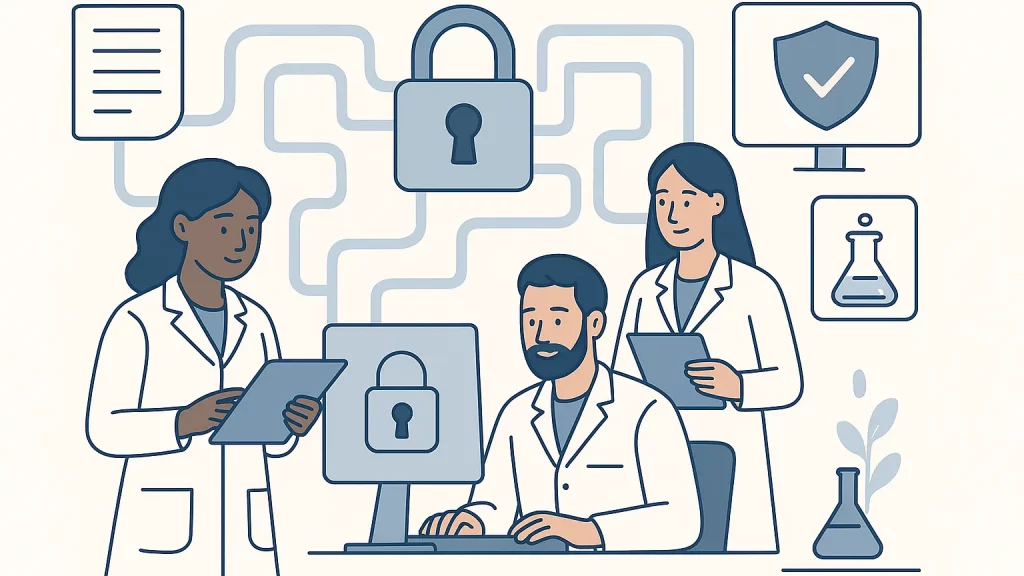
In a modern digital lab, encryption is the simplest, most powerful step you can take to protect lab data and uphold data privacy. Think of it as a lock that scrambles information so only authorized people and systems can read it. Whether you manage a LIMS, operate connected instruments, or share results with partners, encryption reduces the risk of leaks, fines, and downtime while building trust with sponsors and regulators.
Why encryption matters in the digital lab
Laboratories create and move sensitive files every day: assay results, patient identifiers, batch records, and instrument logs. These datasets travel between benchtop PCs, sequencers, storage arrays, and cloud apps. Without encryption, a lost laptop, a misdirected email, or a compromised network segment can expose lab data in minutes. With encryption, that same information is unreadable to attackers. This protection also supports common compliance needs, from HIPAA and GDPR to GxP expectations, and it signals to partners that your data privacy practices are mature.
How encryption works: in transit and at rest
Encryption in transit protects data as it moves between systems. When your instrument PC sends results to the LIMS over HTTPS, protocols like TLS 1.3 wrap the connection so eavesdroppers see only noise. Encryption at rest protects stored files on servers, laptops, backup media, and cloud buckets. Technologies such as full‑disk encryption and database or file‑level encryption use strong ciphers like AES‑256 to keep content safe even if a drive is stolen or a snapshot is copied.
Keys make encryption possible. A key is a secret string your systems use to lock and unlock data. Good practice means generating keys from a secure service, rotating them on a schedule, and limiting who can access them. Many labs use a hardware security module or a cloud key management service to automate these tasks and maintain auditable control.
Practical examples you can apply today
Consider a biobank that stores identifiable donor records and images. By enabling full‑disk encryption on imaging workstations and encrypting the object store that holds raw files, the team can report a lost device as “no breach,” because the data remains unreadable. Or take a QC lab that uploads batch results from instrument PCs to a cloud LIMS. Enforcing TLS 1.3 for all connections, plus automatic server‑side encryption for the LIMS storage, prevents man‑in‑the‑middle snooping and secures archives without slowing workflows.
Building an encryption plan that fits your lab
Start by mapping where lab data is created, transmitted, and stored, from instruments and ELNs to archival cold storage. Turn on encryption by default at each point, then verify it with simple checks like confirming HTTPS locks in browsers and reviewing storage encryption settings in your server or cloud console. Tie access to roles so only the right staff and services can use the keys. Finally, test recovery: restore an encrypted backup and confirm it decrypts as expected. These steps are small, but together they create a strong, low‑friction defense for any digital lab.
The bottom line on encryption
Encryption is not a luxury add‑on; it is a foundation for data privacy and resilient operations in every digital lab. Done well, it protects lab data without adding manual work, and it positions your team for smoother audits and faster collaborations. If you want a clear, tailored path from policy to practice, we can help.
At EVOBYTE we design and implement end‑to‑end encryption for lab systems—from instrument PCs and LIMS connectors to cloud storage and key management—without disrupting your workflows. Get in touch at info@evo-byte.com to discuss your project.
Further reading
NIST SP 800‑111: Guide to Storage Encryption Technologies for End User Devices — National Institute of Standards and Technology: https://csrc.nist.gov/publications/detail/sp/800-111/final
NIST SP 800‑52 Rev. 2: Guidelines for the Selection, Configuration, and Use of TLS Implementations — National Institute of Standards and Technology: https://csrc.nist.gov/publications/detail/sp/800-52/rev-2/final
HIPAA Security Rule Summary — U.S. Department of Health & Human Services: https://www.hhs.gov/hipaa/for-professionals/security/laws-regulations/index.html
GDPR Article 32: Security of Processing — EUR‑Lex: https://eur-lex.europa.eu/eli/reg/2016/679/oj